
UK Investigated Evolution Gaming and NetEnt Merger: What Happened to the Deal?
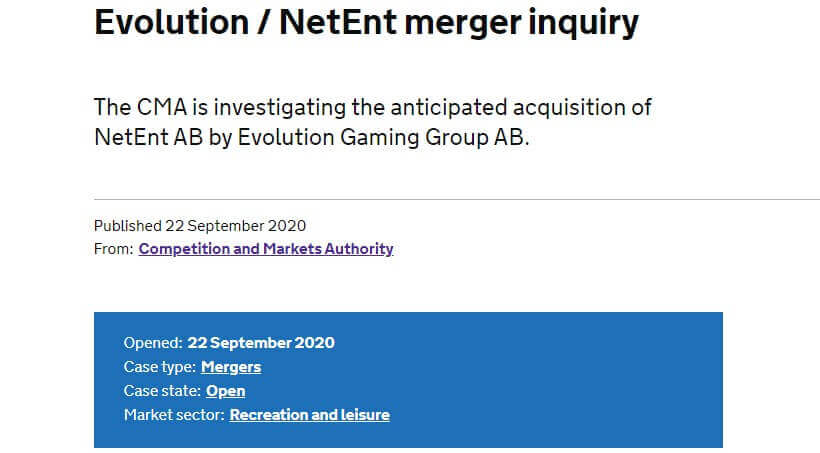
September 2020 – updated with the final CMA decision
The proposed acquisition of NetEnt by Evolution Gaming became one of the biggest online casino industry deals of 2020, bringing together two of the most recognisable gaming software companies in Europe. Before the transaction could be completed, however, it attracted the attention of the UK’s Competition and Markets Authority (CMA).
On 22 September 2020, the CMA formally launched a merger inquiry into Evolution Gaming’s planned acquisition of NetEnt. The regulator wanted to determine whether combining the two companies could substantially reduce competition in any part of the UK online gambling software market.
The investigation did not mean that the CMA had already concluded that the deal was anti-competitive. Instead, it was a standard Phase 1 merger review designed to examine the companies’ businesses, their market positions and the areas in which their products competed.
Update: the investigation was eventually completed successfully for Evolution and NetEnt. On 16 November 2020, the CMA cleared the proposed acquisition and decided that the transaction did not need to be referred for a more detailed Phase 2 investigation.
Why was Evolution Gaming buying NetEnt?
Evolution Gaming announced its public offer for NetEnt on 24 June 2020.
The transaction valued NetEnt at approximately SEK 19.6 billion at the time the offer was announced. Evolution offered NetEnt shareholders 0.1306 Evolution shares for each NetEnt share.
The board of directors of NetEnt unanimously recommended that shareholders accept the offer.
The strategic logic behind the acquisition was relatively clear. Evolution Gaming had established a particularly strong position in the online live casino market, while NetEnt was one of the industry’s best-known suppliers of online slots, RNG casino games and digital casino software.
Bringing the businesses together would therefore create a gaming supplier with a much broader product portfolio covering both major areas of the online casino sector:
- live dealer casino games;
- online video slots;
- RNG table games;
- casino software supplied to operators on a B2B basis;
- gaming content for regulated online gambling markets.
For Evolution, the NetEnt acquisition represented an opportunity to expand beyond its traditional strength in live casino and establish a much larger position in the global online slots market.
When did the UK CMA investigation begin?
The Competition and Markets Authority notified the companies of the launch of its merger inquiry on 21 September 2020, with the formal investigation beginning on 22 September 2020.
The CMA invited gambling operators, competitors, industry participants and other interested parties to submit comments about the proposed Evolution Gaming and NetEnt merger.
The consultation period remained open until 5 October 2020.
The regulator’s Phase 1 statutory timetable originally set 16 November 2020 as the deadline for its decision.
The purpose of the investigation was to determine whether the acquisition would create what UK competition law describes as a substantial lessening of competition.
Did Evolution Gaming and NetEnt actually compete with each other?
At first glance, Evolution Gaming and NetEnt appeared to operate in largely different areas of the online casino industry.
Evolution was primarily associated with live dealer casino games. Its products used real gaming tables, studios, presenters and dealers to stream games such as roulette, blackjack and baccarat to online casino players.
NetEnt, meanwhile, was far more widely known for its extensive catalogue of online slot machines and RNG casino games.
That could make the companies appear complementary rather than direct competitors.
However, the businesses were not completely separate.
NetEnt also operated a live casino division, meaning that both companies supplied live dealer casino products to gambling operators. This was the area that ultimately became the main focus of the CMA’s competition assessment.
The CMA focused on the UK live casino market
In its final assessment, the Competition and Markets Authority identified the principal overlap between Evolution and NetEnt as the supply of online live casino games to gambling operators on a B2B basis in the United Kingdom.
This distinction is important.
The CMA was not simply investigating whether one company owned slot machines while another supplied roulette tables. It examined how gaming software providers competed for positions inside online casinos and how operators selected casino content for UK players.
Online casinos typically integrate games from numerous software providers. Those developers compete for visibility, player activity and preferential placement inside the casino lobby.
The more frequently players use a particular supplier’s games, the more gaming revenue those products can potentially generate for both the operator and the software provider.
Consequently, competition between casino game developers exists even when the companies themselves do not operate consumer-facing online casinos.
Why the merger attracted competition scrutiny
Evolution already held a substantial position in the live casino sector. Acquiring another company that also supplied live casino products therefore created an obvious question for competition regulators:
Would removing NetEnt as an independent supplier leave casino operators with significantly fewer competitive alternatives?
The CMA examined the companies’ market positions, information supplied by Evolution and NetEnt, and evidence from third parties operating in the gaming industry.
The regulator also considered the remaining competition from other online casino software suppliers.
This was particularly relevant because the online casino software market contains a mixture of large international developers and more specialised game studios competing for contracts with casino operators.
What did the CMA eventually decide?
On 16 November 2020, the Competition and Markets Authority announced that it had cleared Evolution Gaming’s proposed acquisition of NetEnt.
The CMA concluded that although the combined company would have a relatively significant presence in the supply of online live casino games, NetEnt itself represented only a relatively small additional competitive presence in that particular segment.
According to the regulator’s assessment, NetEnt did not place a sufficiently strong competitive constraint on Evolution for its removal as an independent company to create a realistic prospect of a substantial reduction in competition.
The CMA also considered the competitive pressure that would continue to be provided by other gaming suppliers after the acquisition, specifically identifying Playtech as an important remaining competitor in the live casino market.
As a result, the CMA decided that the transaction would not be referred to a Phase 2 investigation.
What is a Phase 1 CMA merger investigation?
A Phase 1 review is the CMA’s initial examination of a proposed merger or acquisition.
The regulator considers whether there is a realistic prospect that a transaction could lead to a substantial lessening of competition in a UK market.
If significant competition concerns remain after Phase 1, a transaction can potentially be referred for a much more detailed Phase 2 investigation.
A Phase 2 review may examine market structure, pricing, customer alternatives, barriers to entry and competitive behaviour in much greater detail.
In the Evolution and NetEnt case, this additional investigation was ultimately unnecessary because the CMA cleared the transaction during Phase 1.
The Evolution and NetEnt deal also required approval outside the UK
The United Kingdom was not the only jurisdiction relevant to the acquisition.
The transaction was also subject to competition review in other markets. The Malta Competition and Consumer Affairs Authority approved the acquisition on 29 September 2020.
Receiving the required competition approvals was one of the important conditions attached to Evolution’s public offer for NetEnt.
Following the CMA decision on 16 November, Evolution announced that the required competition approvals for the transaction had been obtained.
What happened after the CMA approved the NetEnt acquisition?
Once UK competition approval had been received, Evolution was able to proceed with the final stages of its public offer.
Evolution announced completion of the recommended public offer for NetEnt shareholders on 23 November 2020.
The integration of NetEnt into the Evolution group then moved forward rapidly, with Evolution reporting NetEnt as part of the combined business from December 2020.
The acquisition significantly changed Evolution’s position in the online gambling software industry.
Before the transaction, Evolution was primarily identified with live casino technology. After acquiring NetEnt, the group gained a considerably larger presence in online slots and RNG casino gaming while retaining its dominant focus on live casino entertainment.
Why the Evolution-NetEnt merger mattered for online casinos
The acquisition was important not simply because of the size of the transaction, but because it represented further consolidation among major online casino software providers.
Casino operators increasingly depend on large content suppliers and aggregation platforms capable of providing extensive game portfolios across multiple regulated markets.
For an operator, working with a supplier that can provide several categories of casino content can simplify technical integration and commercial relationships.
For suppliers, meanwhile, a larger portfolio can provide greater leverage when negotiating distribution agreements and positioning games inside casino lobbies.
The Evolution-NetEnt combination therefore brought together several strategically valuable areas of online gaming technology under one corporate group.
- Evolution contributed its strong position in live dealer casino gaming.
- NetEnt contributed an established portfolio of online slots and RNG games.
- The combined business gained access to a broader range of casino operators and regulated markets.
- Evolution could offer operators a more diversified casino content portfolio.
Evolution Gaming and NetEnt merger timeline
- 24 June 2020: Evolution Gaming announces its public offer to acquire NetEnt.
- 21 September 2020: the CMA notifies the companies about the launch of its merger inquiry.
- 22 September 2020: the UK Phase 1 merger investigation formally begins.
- 29 September 2020: the Maltese competition authority approves the transaction.
- 5 October 2020: the CMA’s period for interested parties to submit comments closes.
- 16 November 2020: the CMA clears Evolution Gaming’s acquisition of NetEnt.
- 23 November 2020: Evolution announces completion of its recommended public offer for NetEnt.
- December 2020: NetEnt becomes part of the combined Evolution business.
Was the CMA trying to block the Evolution and NetEnt merger?
No. The launch of the investigation should not itself be interpreted as a decision to block the acquisition.
The CMA opened an inquiry because the transaction met the criteria for regulatory examination and because there was an overlap between Evolution and NetEnt in the supply of online live casino games.
The regulator then examined whether that overlap was significant enough to damage competition.
After its investigation, the CMA concluded that it was not.
Did NetEnt disappear after the Evolution acquisition?
NetEnt ceased to operate as a completely independent public company after the acquisition, but its gaming catalogue and brand did not simply disappear overnight.
NetEnt games continued to form an important part of the wider Evolution group’s online slots portfolio.
For players and online casino operators, this meant that familiar NetEnt slot titles could continue to be distributed while their developer was now part of a much larger gaming group.
Why did Evolution want NetEnt if Evolution specialised in live casino?
That difference was one of the main attractions of the transaction.
Evolution already had an extremely strong live casino business, while NetEnt had spent years building a recognised catalogue of online slot games and RNG casino products.
Instead of purchasing a business identical to its own, Evolution gained access to a major additional gaming vertical.
The acquisition therefore allowed Evolution to expand its business from primarily live casino software into a broader combination of live dealer games, online slots and RNG casino content.
Final outcome of the Evolution Gaming and NetEnt investigation
The UK investigation into the Evolution Gaming and NetEnt merger ultimately ended without the deal being blocked.
The Competition and Markets Authority launched its Phase 1 investigation in September 2020 and examined the companies’ overlap in the UK online live casino market.
Although Evolution had a strong market position, the CMA found that NetEnt represented only a relatively small additional competitor in live casino gaming and that other suppliers would continue to provide competitive pressure after the acquisition.
On 16 November 2020, the CMA therefore cleared the transaction.
The acquisition subsequently went ahead, bringing together one of the world’s best-known live casino developers and one of the most established names in online slot development.
What originally appeared in September 2020 to be a potential regulatory obstacle ultimately became another step in the rapid consolidation of the international online casino software industry.